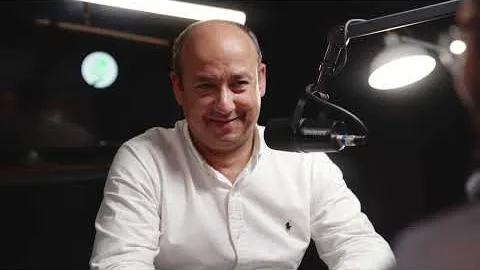
Moving a heavy industrial load requires more than increasing the capacity of a standard robot. The shape of the load, the surrounding equipment, the route and the consequences of a mistake all influence the solution. Miguel de Sebastián describes that combination of constraints as the territory of special mobile robotics.
Speaking as DTA’s General Manager, he traces the company’s development from a family business representing other manufacturers to an engineering organisation building its own machines. His account combines ambitious applications with a careful view of safety, commercial fit and growth.
De Sebastián trained as a naval architect, following a family connection with the profession. DTA itself had close ties to shipbuilding, reflected in its original Spanish name, Desarrollo de Técnicas para Astilleros.
He explains that the company initially sold products from other manufacturers. A turning point came when a German supplier failed during an important project. DTA still needed to fulfil its commitment, so his father worked with engineers from that supplier to complete the job.
That experience led to products sold under DTA’s own brand. Later, de Sebastián and colleagues pushed to bring more engineering inside the company. Mechanical design came first, followed by electrical design and further technical capabilities. He describes the progression as a series of cautious steps rather than a single transformation.
What does special mobile robotics mean?
Heavy loads are an important part of DTA’s work, but de Sebastián gives the term a broader meaning. A special application may require a tailored design because a suitable product is not available from a standard catalogue.
The company also came to automation through remote-controlled, battery-powered transporters. Those machines already contained substantial software and control capabilities. Fully automatic systems developed alongside manual and semi-automatic equipment as customer requirements changed.
He does not treat maximum automation as the correct answer to every enquiry. The appropriate solution depends on the movement, its frequency and the investment case. A sophisticated system can be unnecessary if a simpler design performs the required task well.
What makes an application demanding?
De Sebastián recalls DTA’s contribution to the Ariane 6 programme with particular pride. He describes four AGVs used to move the rocket from final assembly towards the launch area and coordinate with equipment involved in its vertical positioning.
Other examples in the interview include handling for the aerospace industry, nuclear-waste applications and equipment used to move a football stadium’s playing field. These are very different operations, but all require close attention to the object being moved and the system around it.
The engineering deliverable can therefore include extensive documentation as well as the machine itself. Validation requirements, checks and evidence form part of the work, especially where the consequences of an error are serious.
How does safety shape the design?
For de Sebastián, safety belongs at the beginning of an automatic system’s design. It cannot be treated as an accessory added after the movement has been solved.
Large or unusually shaped loads create challenges beyond the footprint of the transporter. He gives the example of moving an aircraft structure whose height and geometry make it difficult to monitor every possible interaction with its surroundings. In some applications, a person retains an enabling role using a dead-man control.
He also identifies outdoor operation as an area where safety technology affects the pace of adoption. The demand for moving materials between buildings can be substantial, but the operating environment creates additional conditions that must be managed before automation can be deployed responsibly.
Is obstacle avoidance always the right objective?
De Sebastián questions the assumption that every heavy-load vehicle should simply reroute around anything in its path. With a large industrial load, an unexpected change of route can create its own complications.
For the kinds of applications DTA serves, he often favours a controlled route and clear coordination between automatic vehicles and manually operated equipment. Communication and traffic organisation matter as much as the ability of one robot to detect an obstruction.
That preference does not mean avoiding new technology. He describes an active interest in sensors, localisation methods and research that could improve the company’s systems. The test is whether a new capability makes the whole application more dependable.
Why did joining Enerpac matter?
The interview took place after DTA became part of Enerpac Tool Group in 2024. De Sebastián describes the selection of a partner as important to the company’s future and to the people who worked there.
He sees the backing of a larger group as helpful when bidding for substantial projects. Customers may be concerned if a single contract represents a large share of a supplier’s existing business. Greater organisational and financial support can help address that concern.
At the same time, he emphasises continuity in DTA’s specialisation and quality expectations. The aim he describes is to grow the business while retaining the engineering focus that attracted its customers in the first place.
How do you prepare a specialist business to scale?
De Sebastián describes working backwards from delivery. Assembly, testing, purchasing, project management, engineering and after-sales support needed attention before the company increased its sales effort.
The reasoning is straightforward: generating more orders is unhelpful if the organisation cannot execute them well. Testing before shipment is particularly important in his account, including milestones agreed with customers.
He also discusses standardising products that have emerged from specialist work. This involves more than repeating a design. The entire path from quotation to delivery needs to become more consistent, while still serving applications that differ from ordinary catalogue equipment.
What role do people play in that growth?
De Sebastián credits the wider team, including the people assembling and finishing the machines, rather than presenting the transformation as a management achievement alone. Bringing more work inside the business made those skills increasingly important.
His comments on the Spanish industrial workforce follow the same logic. Engineering education matters, but so does technical training for people who build, commission and maintain equipment. A growing manufacturer needs both.
The personal lesson he draws is a willingness to leave familiar routines when circumstances require change. DTA’s history, as he tells it, is a succession of such decisions, supported by the people capable of turning each new direction into working machinery.
Frequently asked questions
Does special mobile robotics only mean heavy loads?
No. It also includes applications requiring tailored equipment that a standard product cannot adequately serve.
Why might a heavy-load robot use a controlled route?
Predictable movement can be important when the load, surrounding equipment and mixed traffic make unplanned rerouting unsuitable.
What should come before increasing sales?
De Sebastián recommends preparing the delivery organisation, including engineering, purchasing, assembly, testing and support, so it can handle the additional work.