For an autonomous inspection robot, useful work begins with a precise assignment: patrol a site, observe equipment or collect information that helps someone decide what to do next. The shape of the machine, its sensors and its software should follow that assignment.
In this Industry Focus interview, Star Robotics founder and CEO Ángel Alejandre describes the engineering and commercial decisions behind that approach. He discusses the company’s Watchbot platform, the value of combining mobile inspection with existing security systems, and the importance of being candid about what a robot can and cannot do.
His account focuses on task-specific autonomy. The interview also contains development ambitions and experiments, which are distinguished here from capabilities described as deployed at the time of the conversation.
Start with observation, not a universal robot
Alejandre traces the company’s work from earlier experience with remotely operated machines for hazardous environments towards autonomous civil applications. The process involved development, pilots and feedback from prospective customers before moving into commercial use.
Watchbot’s central function in the discussion is observation. A mobile platform can patrol and carry cameras or other sensors to collect information around a site. Depending on the application, Alejandre discusses visual, thermal, acoustic and gas-related inspection.
This task definition sets boundaries. The platform described in the interview does not climb stairs, and its main purpose is not general manipulation. Those limitations are important purchasing information. A customer needs a machine suited to the site and inspection task, rather than an assumption that autonomy implies every kind of physical capability.
When does mobile inspection add value?
Alejandre points to large premises and applications in sectors such as energy and water. A mobile robot can change its observation point and gather information across an area, complementing equipment that remains in a fixed location.
He also recognises that mobility must justify itself. A small site that can be covered adequately with a few fixed cameras may not need a patrol robot. The business case therefore depends on the inspection area, the required observations and the work already performed by people or existing systems.
In his account, robots can support security personnel while people retain responsibilities such as access control and responding to situations. That is a description of how these applications can be organised, not a guarantee about employment outcomes across all deployments.
Design the platform around the operating conditions
The choice between wheels, legs and other mechanical arrangements should follow the mission. Alejandre favours a purpose-designed wheeled platform for the inspection tasks he describes, while acknowledging its physical limits.
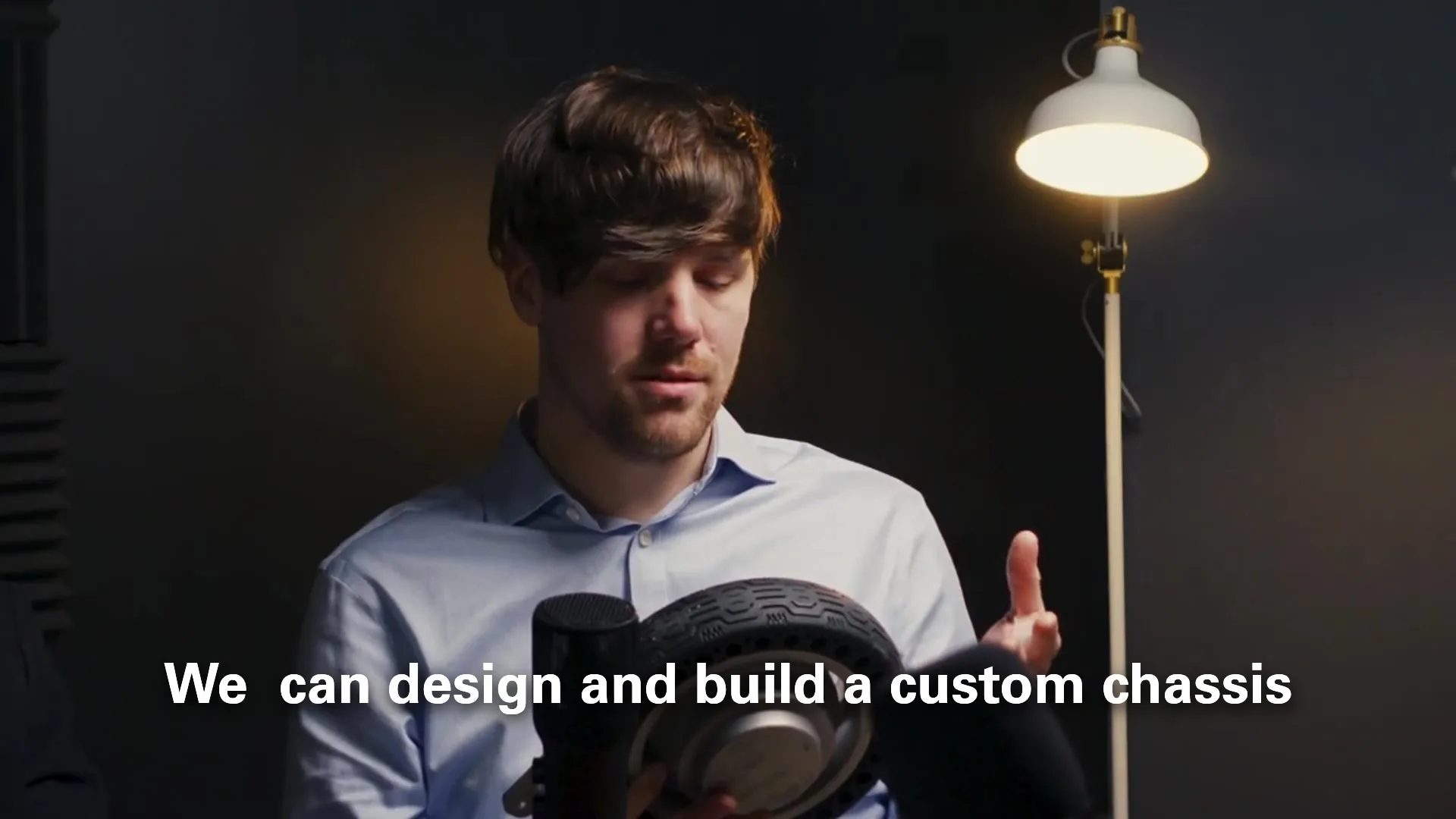
He explains that the company develops mechanics, electronics, navigation and cloud software, with fabrication partners supplying parts that are then integrated into the system. The advantage he emphasises is control over how the complete product fits together and how it can be adapted to a customer’s requirements.
Modularity still matters within that approach. Different sensors and payloads can serve different inspections without treating every installation as an entirely new robot. The practical objective is to reuse a coherent platform while accommodating the information the customer actually needs to collect.
Navigation depends on the environment
Alejandre describes LiDAR-based mapping and navigation for indoor and outdoor operation. He also makes clear that localisation depends on usable environmental references. An area with few distinguishing features can present a different challenge from a structured industrial space.
This is a useful reminder for procurement and pilot planning. A general statement that a robot works outdoors does not describe every outdoor condition. The proposed route, available reference features and specific operating requirements need to be assessed together.
The interview mentions possible additional positioning approaches as development options. These should be treated as options discussed at the time, rather than assumed features of every supplied robot. The same discipline applies to any future capability in an evolving product.
An alert has to earn the operator’s trust
The sensing architecture described combines onboard detection with further analysis in the cloud. Alejandre discusses camera coverage around the robot and the use of additional processing to evaluate detections and reduce false alarms.
His concern is operational credibility. An alerting system that repeatedly creates unnecessary work can lose the confidence of the people expected to act on it. Successful detection is therefore more than producing a large number of notifications; the results must be useful within the customer’s workflow.
Integration contributes to that usefulness. Alejandre describes connecting through APIs to existing customer systems instead of always requiring another separate dashboard. For an operator, an inspection result is more valuable when it arrives where action can be taken and can be understood alongside other information.
What role can generative AI play in inspection?
The interview explores experiments with applying generative AI to selected images, including questions about doors, lights and visible changes. Alejandre presents this as a developing area, with potential to make some inspections easier to configure.
He also identifies a traceability problem: a changing model can behave differently over time. That makes it important to understand how an inspection conclusion was produced and whether the system continues to behave as expected.
The distinction between an experiment and a dependable operational function is central here. A promising image interpretation does not establish consistent performance across all sites or conditions. For industrial use, the relevant test is whether the inspection produces sufficiently reliable and understandable information for the intended decision.
Prove the application and state the boundaries
Alejandre describes pilots as an opportunity to demonstrate whether the robot fits the customer’s environment and requirements. He also discusses commercial models involving purchase or subscription and maintenance responsibility. These are models described in the interview, not a current price list or contractual offer.
His broader recommendation is straightforward: explain what the system can do now, what it cannot do, and what might be possible with additional development. That distinction is particularly valuable in robotics, where a successful demonstration can easily be mistaken for a general capability.
For an industrial buyer, the resulting checklist is practical. Define the inspection, establish the physical and environmental limits, test the quality of the information, and agree how results will enter the existing workflow. The value lies in a repeatable task that helps the organisation, rather than the novelty of the machine performing it.
Frequently asked questions
What is an autonomous inspection robot used for?
In this interview, the focus is mobile observation and data collection around industrial or other large premises, using cameras and application-specific sensors to support inspection and security workflows.
Does a mobile robot replace fixed cameras?
Not necessarily. Alejandre describes mobile and fixed systems as potentially complementary. A robot must offer a useful benefit for the size of the site and the required task.
Why are false alarms an important design issue?
Repeated unnecessary alerts create work and can undermine operator confidence. Detection must be evaluated in terms of useful, actionable information rather than notification volume alone.
Are all capabilities discussed commercially available?
No. The interview includes existing functions, experiments and possible future developments. Buyers should confirm the configuration and capability of a specific system rather than treating the entire discussion as a product specification.