José de Gea on Building Robots for Difficult, Unpredictable Work
José de Gea discusses harsh-environment robots, human interaction, humanoids and the challenge of combining perception, planning and control.
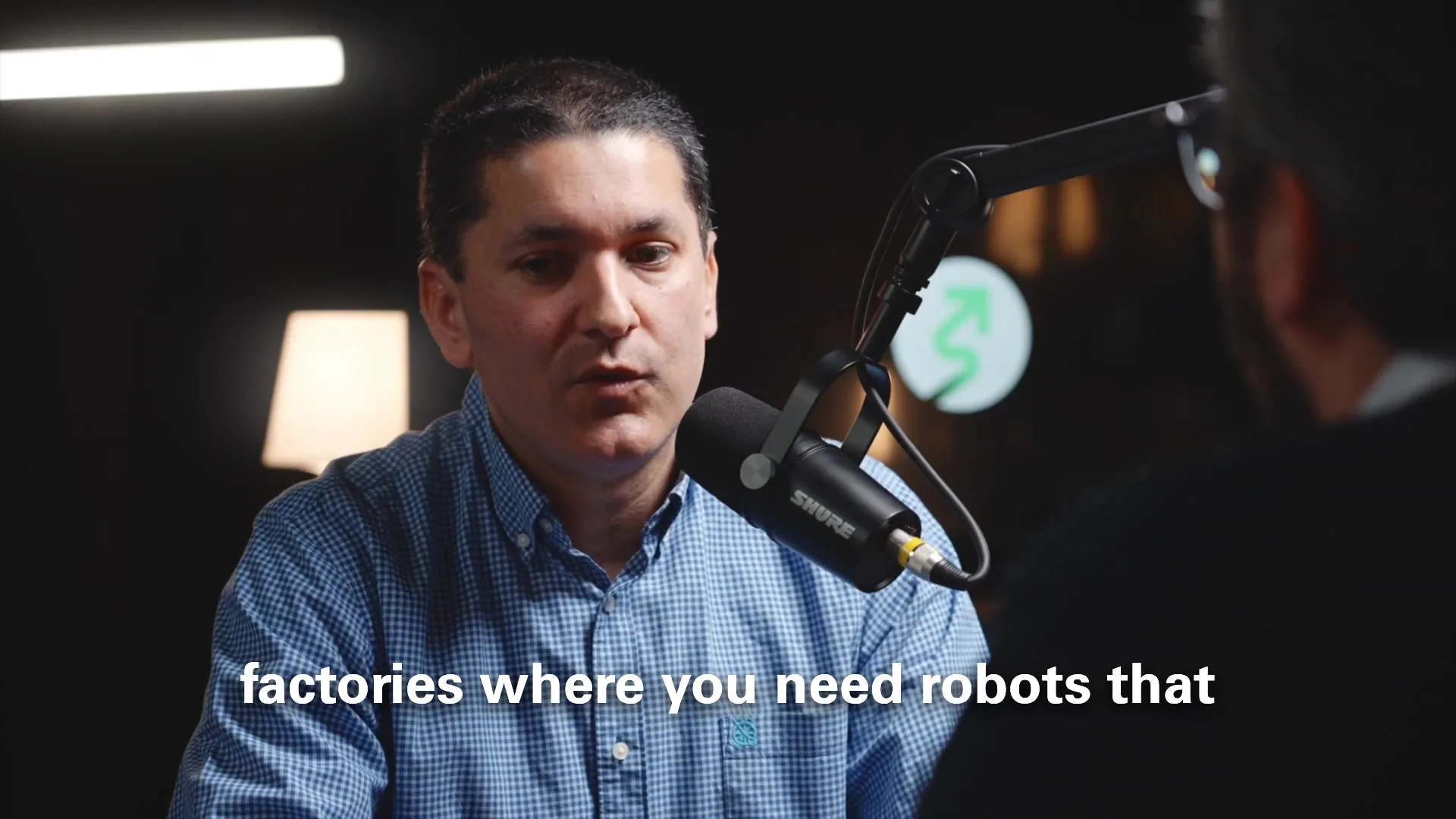
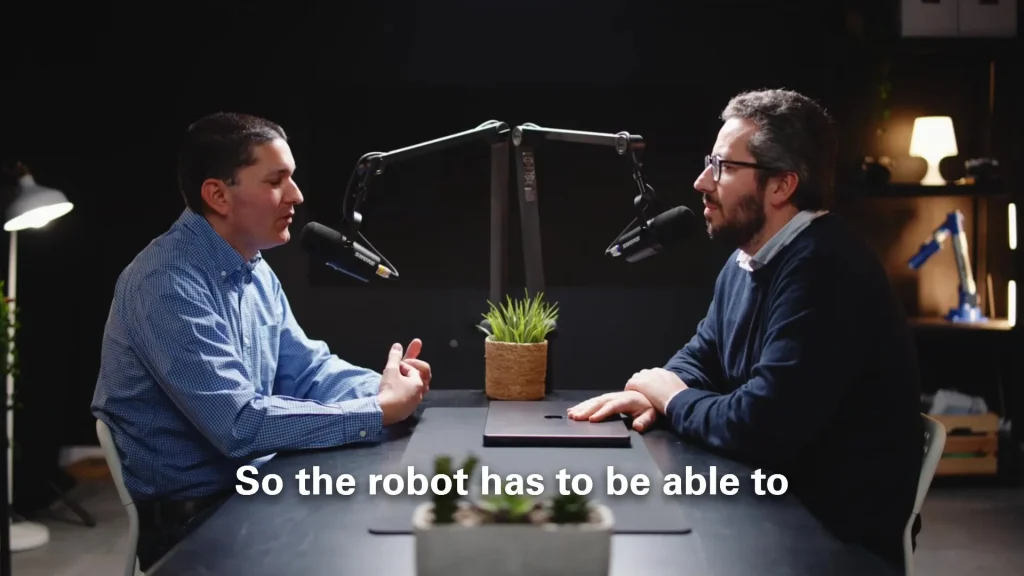
José de Gea Fernández in conversation with Industry Focus. Image: Industry Focus.
A robot can demonstrate impressive perception, manipulation or navigation and still struggle to complete a useful job. José de Gea Fernández sees bringing those capabilities together as one of robotics’ most important challenges. The machine must carry its own computing and power, respond to changing conditions and recover when reality interrupts the plan.
Introduced in the interview as Yardstick Robotics’ vice president of manipulation and control, de Gea connects that challenge to a career spanning research and industrial applications. His interest is in the work that remains difficult to automate: tasks in harsh environments, interactions with people and situations that cannot be specified completely in advance.
An engineer who wanted to build things
De Gea traces his technical curiosity to opening electronic devices as a child. Rather than following the educational route others expected, he chose vocational electronics training because he wanted practical knowledge. Engineering studies followed, along with a move to Germany that eventually brought him into robotics at the University of Bremen.
He recalls building circuit boards and small electronic projects at home. The satisfaction came from assembling something and seeing it work. Robotics expanded that experience into mechanical and software systems that could act on the physical world.
That practical motivation remains visible in his account of research. He resists the idea that work without an immediate commercial application has little value. Technologies that seem to arrive suddenly, he argues, often depend on years of earlier investigation and on people carrying that knowledge into companies.
José de Gea Fernández speaking to Industry Focus. Image: Industry Focus.
What a research humanoid made possible
One project stands out in de Gea’s recollection: a humanoid-style system with a head, two arms and a movable torso on a wheeled base. The team chose wheels because legs would add complexity without a sufficient benefit for that project.
He remembers the machine as an important technical milestone and an unusually personal one. More significantly, it brought together work on perception, dual-arm manipulation, mobility and task planning. Those capabilities later informed industrial collaboration projects, including demonstrators for automotive and aerospace applications.
The sequence matters. A research platform can provide a place to integrate capabilities before an industrial customer knows exactly how to request them. The subsequent value comes from adapting that knowledge to a specific use case, with different constraints and a clearer operational purpose.
The challenge is making the capabilities cooperate
De Gea describes a robotics landscape rich in specialist achievements. One team may make progress in navigation, another in manipulation, another in planning. A useful autonomous system must make those advances work together within a limited physical package.
Computing capacity, battery endurance and available space all constrain the design. The robot cannot simply carry unlimited hardware to solve each problem separately. Its software also needs to coordinate sensing, decisions and actions in a way that supports the task as a whole.
This is why a successful laboratory demonstration does not automatically establish readiness for extended work. The interview directs attention toward system behavior: what the robot can complete, how long it can continue and what happens when a component or assumption no longer performs as expected.
Safety begins with the application
For collaborative robots, de Gea identifies moving mass and actuator design as persistent concerns. Compact electrical drives have improved, but a robot’s physical interaction with people still needs careful engineering. He is interested in lighter structures and alternative actuation principles that could change those constraints.
He also emphasizes application-level risk assessment. The people nearby, the task, possible contact and the robot’s operating state affect what protective measures are appropriate. A manufacturer can provide useful safety functions, but the complete installation still needs to be assessed.
His discussion of humanoids makes the issue especially clear. A machine that depends on active balance cannot be treated as though removing motor power always produces a safe outcome. Loss of power and loss of stability need to be considered together. The interview raises these as design challenges, rather than offering a certification procedure or universal safety prescription.
Harsh conditions change more than the enclosure
De Gea’s interest in difficult environments comes from work on space exploration, underwater systems and search-and-rescue robotics. Those settings connect mechanical durability with a second problem: the environment may be poorly structured and constantly changing.
He discusses agriculture, offshore inspection and food-industry cleaning as examples of demanding conditions. Temperature variation, water, dust and salt exposure can change what is required of a manipulator. A protective cover may help in some circumstances, but he advocates designing with the intended conditions in mind.
The software faces its own moving target. A map can become outdated, an obstacle can appear and changes in lighting can affect perception. A robot needs ways to recognize those changes and adjust its behavior. In some situations, asking an operator for help is a sensible part of the operating concept.
That last point makes his view of autonomy pragmatic. The objective is useful work with an appropriate level of independence, including a defined path for human intervention.
A coffee request reveals the planning problem
De Gea uses a familiar task to explain why adaptability is difficult: asking a robot to bring a coffee. The instruction contains several hidden steps, from reaching the kitchen to locating a cup and operating the machine.
Breaking the request into steps is only part of the job. The cup may be missing, the coffee supply empty or the machine leaking. The robot then needs to decide whether to find an alternative, change its plan or request assistance.
He argues that enumerating every possible exception in advance is impractical. His expectation is that useful systems will combine structured reasoning with methods that learn from data and experience. The interview presents that combination as an important direction of development, not proof that general-purpose autonomy has already been achieved.
He also distinguishes language-based interaction from physical execution. A language model may help interpret a request, while established optimization and control methods still perform important work in planning and carrying out movement.
Choosing a form that serves the task
De Gea takes a measured view of humanoids. For many applications, he would choose a wheeled platform with a manipulator because it can be a practical, robust solution. He nevertheless sees potential value in a body configuration that can use environments designed around people.
Stairs, shelves and tasks involving two hands illustrate that possibility. Whether a humanoid is competitive depends on its actual capabilities, reliability and economics. His position leaves room for new designs without turning their promise into a requirement for every automation project.
The takeaway
De Gea’s account brings the discussion back to complete systems. Progress means combining mechanics, perception, planning and control so a robot can perform useful work under real constraints, including the moments when it needs human help.
Frequently asked questions
What makes harsh-environment robotics difficult?
The machine must withstand physical exposure while coping with changing surroundings and task conditions. Hardware resilience and adaptable behavior need to develop together.
Does de Gea see humanoids replacing wheeled robots?
He describes advantages for both forms. Wheels can be appropriate for many tasks, while human-like configurations may help in spaces designed for people.
Do language models replace traditional robot control?
In his account, they complement established methods. Interpreting an instruction and executing a controlled physical movement involve different capabilities.
Free membership
Keep reading — it’s free.
Join with your company email to read every case study, interview and article in full. No payment, no card.