Simon Houghton: Build Warehouse Automation Around the Whole Operation
Geek+’s Simon Houghton explains goods-to-person robotics, warehouse bottlenecks, data analysis and phased implementation.
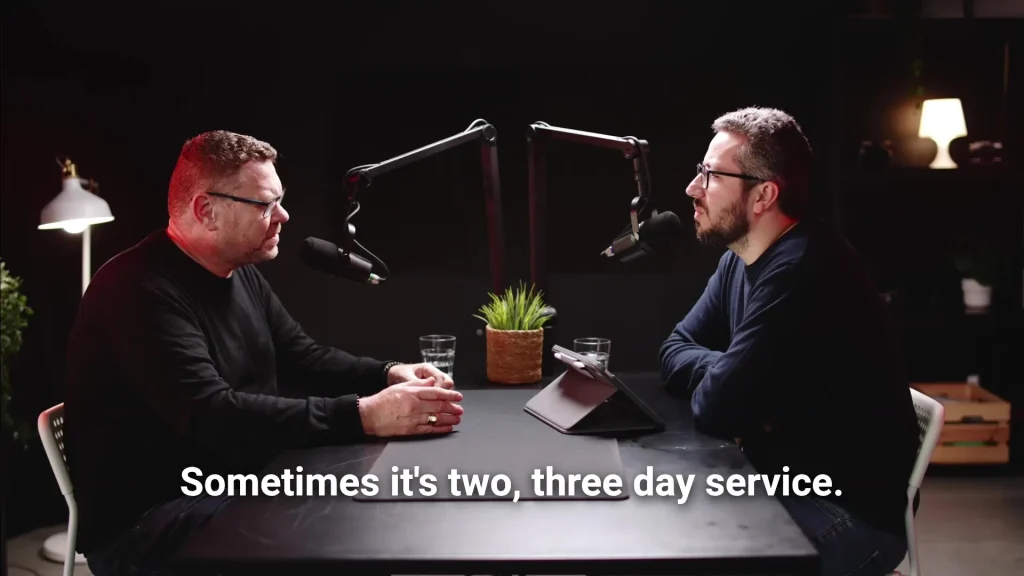
Simon Houghton in conversation with Industry Focus. Image: Industry Focus.
A warehouse can automate picking and still struggle to get orders out of the door. If packing or dispatch cannot absorb the additional flow, the bottleneck has simply moved. In this Industry Focus interview, Simon Houghton explains why goods-to-person robotics needs to be considered within the complete operation, from incoming stock to outbound orders.
Houghton brings experience from both sides of the purchasing decision. Before working with automation suppliers and Geek+, he ran a technology distribution business and recalls joining colleagues in the warehouse when order volumes peaked. His Northern Europe sales role is also documented in Geekplus’s own company announcement.
Let robots handle travel where travel adds little value
Houghton’s starting point is the movement involved in manual fulfillment. People travel to stock, bring items back and repeat the process. Goods-to-person systems change that arrangement by bringing storage units or containers to a workstation.
The potential benefit is not only a faster individual movement. It changes how the picking task is organized. Workers can remain in a defined area while robots carry out transport, reducing the need to walk between dispersed locations.
Houghton also describes a different working environment around the station: colleagues nearby, appropriate lighting and a more comfortable place to perform the task. These are design opportunities rather than automatic consequences of buying robots. They depend on how the station and surrounding process are implemented.
His own distribution experience gives the argument a practical basis. During peaks, the entire office could become involved in preparing orders. Automation, in this framing, is a way to make capacity less dependent on repeatedly improvising around those peaks.
Simon Houghton speaking to Industry Focus. Image: Industry Focus.
Order and product profiles determine the right solution
Houghton resists the idea that one storage architecture is best for every warehouse. Dense storage can be valuable, but a company’s goods and order patterns determine how well a particular system fits.
He discusses situations in which some products fit into totes while others do not. A hybrid arrangement that combines different storage formats may therefore be relevant. He also emphasizes how demand is distributed across stock-keeping units, or SKUs. A system needs to provide suitable access to the products that customers actually order.
The practical requirement is data analysis before design. What products are stored? In which quantities? How do orders combine those products? What changes during seasonal peaks? Houghton warns that discovering unsuitable or incomplete data halfway through the design process can lead to the wrong solution.
For a complex operation, he sees value in outside advice that is informed by a broad understanding of available technologies. The adviser should help establish the requirement and extract useful data, rather than begin with a predetermined equipment choice.
Fleet performance depends on hardware and software together
An AMR may appear simple from the outside, but Houghton argues that reliable operation at scale depends on more than its basic ability to move. Hardware must handle the intended load and operating conditions, while software coordinates the fleet and the location of inventory.
He discusses dynamic stock positioning as an example. If demand changes, the desirable location of fast-moving goods may change as well. The software’s decisions about storage and retrieval therefore influence the amount of transport needed to serve orders.
Traffic coordination is another consideration. A successful demonstration with a small number of robots does not establish how a larger fleet will perform under sustained demand. Buyers should ask about the intended operating scale and the evidence supporting it.
Houghton also contrasts navigation approaches, including marker-based systems and SLAM, which uses sensor information to support mapping and localization. His broader point is to match navigation and operating arrangements to the application. A navigation label alone does not establish throughput, flexibility or suitability for working around people.
Check the next process before increasing throughput
One of the interview’s most useful observations concerns the processes outside the robotic area. Faster picking can expose insufficient packing capacity. More packed orders can create pressure at sorting or dispatch.
Houghton recommends examining those upstream and downstream activities when planning an installation. How does stock enter the system? How are completed picks transferred to packing? What happens after parcels are prepared? Conveyors, packing equipment and other automation may need to be considered alongside robots.
The lesson is to judge improvement at the order or service level. A higher output from one subsystem is useful when the rest of the operation can turn it into the intended result. Otherwise, additional work accumulates between stages.
This does not require automating every process at once. Houghton suggests a longer-term plan in which successive investments complement one another. Each stage should have a defined purpose and a clear relationship to the overall material flow.
Use phased implementation to learn without losing direction
Houghton describes installations introduced alongside existing warehouse operations and smaller proof-of-concept areas used before expansion. Both approaches depend on planning the interaction between the new equipment and the work already taking place.
A trial should help the business learn about the application, not simply demonstrate that a robot can move. It can provide evidence for an internal investment discussion and expose practical requirements before the system expands.
He also distinguishes a busy, labor-intensive operation from a low-volume site with little transport work. A company’s overall size does not determine whether a particular warehouse activity justifies automation. The business case needs to reflect that site’s volumes, tasks, costs and operating pattern.
That qualification is important when discussing payback. Houghton reports attractive examples in the interview, but their results cannot be assumed for a different operation. A credible evaluation must connect the proposed investment to the work it is expected to change.
Integrators connect the equipment and the operating model
For Houghton, integrators have an important role because projects increasingly involve more than a robot fleet. They can bring together conveyors, packing systems and other equipment, and support the installation after commissioning.
That continuity matters as the warehouse develops. A later project may add robotic picking or another material-handling process. A clear integration approach makes it easier to understand how the additions will connect and who will maintain the combined system.
People remain part of this future. Houghton expects demand for programming, engineering, maintenance and project skills, even where repetitive transport is automated. Preparing those capabilities belongs in the plan alongside the physical installation.
For Industry Focus readers, the interview offers a clear sequence: understand the order profile, identify the constraining process, examine adjacent activities and choose a realistic first phase. The strongest proposal explains how today’s improvement contributes to tomorrow’s warehouse.
Frequently asked questions
What does goods-to-person automation change?
It brings goods or storage units to a worker’s station rather than requiring the worker to travel to each item. The complete benefit depends on the design of picking, replenishment and adjacent processes.
Can warehouse automation be introduced in phases?
Yes. Houghton describes smaller trials and staged installations. The phases still need a shared plan so that subsequent equipment and processes work together.
Why examine packing before automating picking?
Packing may become the next bottleneck if picking output increases. The investment should improve completed-order flow, not only the performance of one subsystem.
Free membership
Keep reading — it’s free.
Join with your company email to read every case study, interview and article in full. No payment, no card.