ICRA 2026: what the humanoid demonstrations reveal—and what they leave open
The floor report connects visible humanoid hardware with questions about research, control and intended use.

The recorded ICRA 2026 report captures a range of humanoid and hand demonstrations, with exhibitors discussing hardware, data and different safety-related behaviours. Its strongest value is the opportunity to compare what is physically shown with the broader ambitions expressed in the interviews.
This article is a retrospective of that short recording. It does not independently validate product claims or determine whether a demonstrated robot is suitable for a particular application.
Dexterity is one part of the system
The opening interview describes a hand using a combination of tendon-driven and direct-drive mechanisms. The speaker identifies 23 degrees of freedom and discusses general-purpose ambitions.
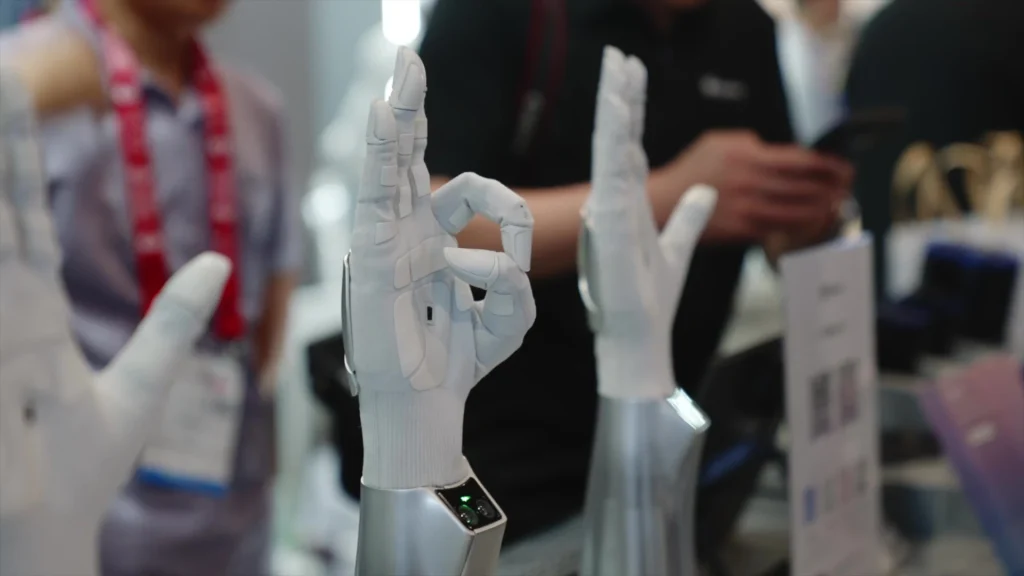
The film makes the hand’s structure visible, but it does not provide a test of manipulation reliability, lifetime or performance across tasks. A demonstrated mechanism and a validated general-purpose capability are different forms of evidence.
The speaker also connects algorithm development with stable, usable hardware and data. That is a useful reminder that progress in robot behaviour depends on more than the visible mechanism.
Research platforms have a different purpose from production deployments
Another interview introduces a full-size humanoid called Ori as a research platform. The speaker describes an emergency input intended to produce a slower fall when a problem occurs.
That explanation concerns the platform being discussed. It should not be expanded into a statement about all humanoids or interpreted as proof of a complete safety case. The report does not show the validation conditions behind the response.
The research designation is also important in its own right. Equipment designed to support experiments should not automatically be described as ready for unattended industrial work.
Exhibitors describe several layers of behaviour
Other speakers discuss stopping when a person is in front of a robot, sensing force and responding to a fall. These comments suggest that participants were thinking about interactions at more than one level.
The descriptions remain exhibitor accounts. The presence of a button, camera or lidar does not by itself establish the behaviour of a complete system under all relevant conditions. This recap therefore avoids turning a short floor explanation into a certification claim.
The questions that remain after the demonstration
The film includes expansive statements about robots working in homes and factories. Those are ambitions and product positioning in the source, not proof that every task has been solved.
A useful reading of the archive asks which task is demonstrated, what remains under operator supervision, what data supports the claimed capability and which environment the system was designed for. Those questions are an editorial framework for following up on demonstrations.
ICRA’s recorded floor conversations are valuable precisely because they show the connection between tangible hardware and open development questions. The next evidence needed is task-specific performance and validation, rather than a broader promise of generality.