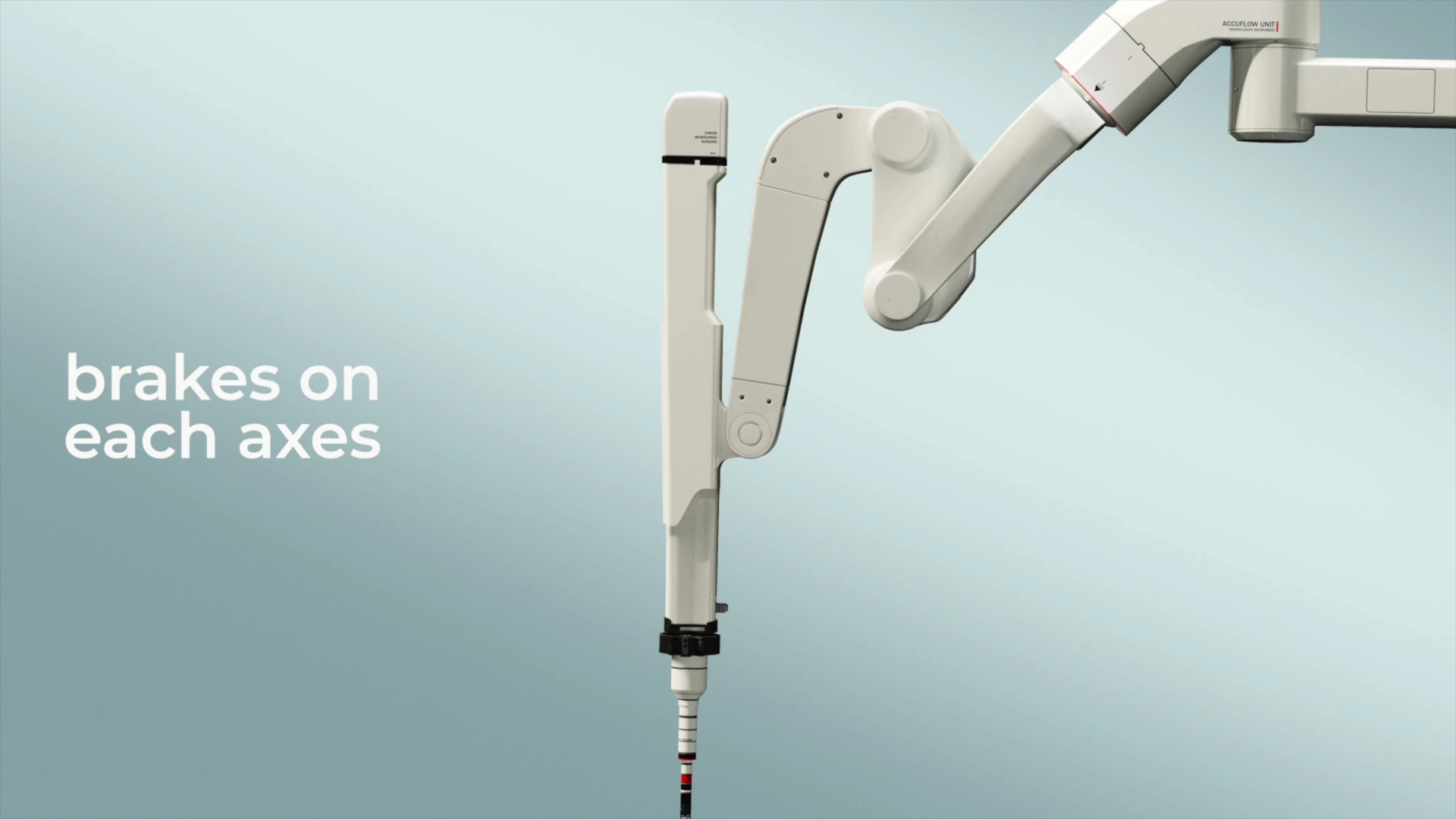
Illustration of the robotic arm and its axis brakes in the A2V film. Frame from the source recording.
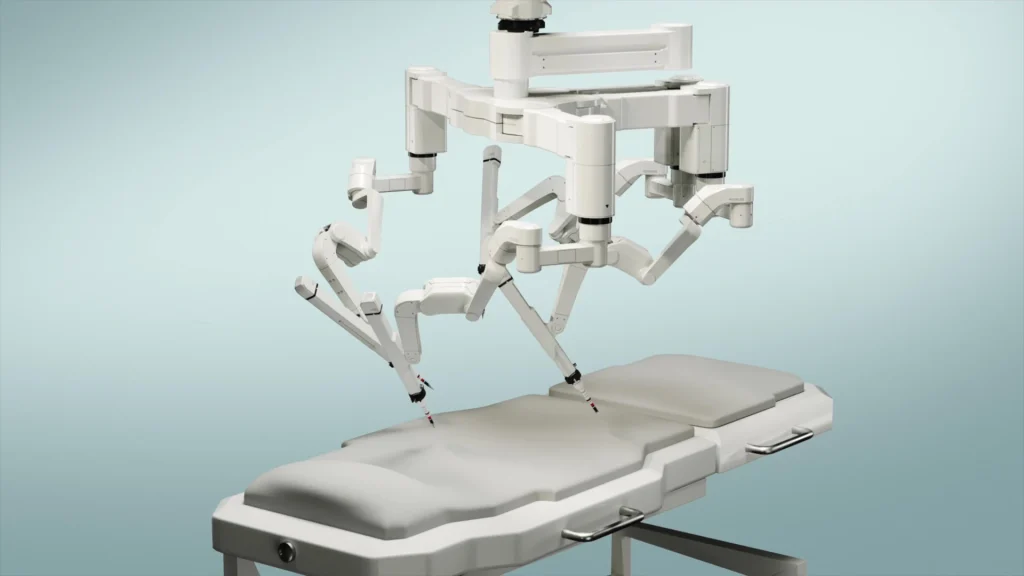
A compact control board is useful only if it connects the functions the machine actually needs. A2V’s recorded technical case illustrates that point through a five-axis robotic arm intended for a medical application.
The source describes a space-constrained architecture involving motors, brakes, feedback, communication and safety-related functions. Its main contribution is an account of integration. It does not establish clinical effectiveness, regulatory approval of a medical device or an independently validated production programme.
The source starts with a system requirement
The film describes five axes using frameless brushless DC motors below 750 watts, with brakes on each axis and two redundant absolute encoders. It also identifies EtherCAT communication and safety-related requirements.
Five-axis medical robotic-arm illustration shown in A2V’s architecture case. Frame from the source recording.
These details are presented as requirements of the project discussed. They are not a recommended specification for medical robots in general. Different mechanisms, loads and applications would require their own analysis.
The important relationship is between the functions. A motor needs a drive, but the complete axis also involves the brake, feedback signals and the interface to the wider control system. Packaging those elements is part of the architecture problem, not merely a matter of finding a smaller board.
Why the limited space matters
According to the film, the design had to concentrate control, communication and brake management in a restricted electronic footprint. A2V built the solution around a compact interface board incorporating motor control, brake control, I/O management and the communication interfaces.
That changes how the project should be described. It is not simply a component substitution or a generic board design. The source presents an arrangement intended to connect multiple functions while preserving a path towards repeatable manufacturing.
The film also discusses a path towards several hundred robots per year. It does not show that this production volume had been reached. A design objective for serial production and demonstrated annual output are different facts.
The role of the servo drives
The recording identifies Elmo Platinum Twitter servo drives as part of the solution. It says they were selected for the project’s demanding EtherCAT architecture and safety-function needs.
Elmo’s current product documentation describes Platinum Twitter as a compact servo-drive family with functional-safety support and safety over EtherCAT. That supports the identification of the component family and its published feature set. It does not establish approval of the complete A2V system or a medical device incorporating it. Product reference.
Keeping those boundaries clear improves the article’s technical usefulness. A component capability belongs to the component and configuration documented by its supplier. The behaviour and evidence of a complete machine involve additional integration work.
Read the architecture through its interfaces
The case can be understood through four connections: the drive to the motor, the controller to the brake, the electronics to the feedback devices, and the subsystem to the machine network. The film names each of these areas, making their integration its central theme.
For readers comparing technical case studies, a useful next question is what evidence describes those interfaces. A source that identifies the communication path and the brake-management role is more specific than one that merely calls an assembly compact or precise.
This is an editorial framework for reading the case, rather than instructions for designing or commissioning a medical robot. The short recording does not include detailed schematics, validation reports or the complete risk assessment.
What the source establishes
The film supports an account of A2V developing an integrated motion-control architecture for a five-axis arm and selecting a compact servo-drive family. It also explains the intended direction towards serial production.
It does not supply quantitative before-and-after footprint measurements, a validated reliability dataset or evidence of clinical use. Those omissions need not obscure the integration story, but they limit the conclusions that can responsibly be drawn.
Questions answered
What is the main engineering theme? Bringing motor control, braking, feedback and communication together within a restricted space.
Does the component’s feature set prove approval of a medical device? No. The two claims concern different scopes of evidence.
Had the annual production target been achieved? The film describes a path to serial production, not verified annual output.
Free membership
Keep reading — it’s free.
Join with your company email to read every case study, interview and article in full. No payment, no card.