Opening title of Synapticon’s recorded humanoid-safety expert talk. Frame from the source recording.
What does it mean for a humanoid robot to reach a safe state? In Synapticon’s recorded expert discussion, The Robot Out of the Cage: Beyond Safe Stop, the answer starts with the difference between stopping a joint and controlling the behaviour of a whole machine.
For a robot that actively balances, the panel argues, abruptly arresting movement can leave an unstable body. Its discussion connects motion monitoring, the location of people and the context of the task. This article reports that engineering perspective; it does not validate a particular robot or prescribe a safety implementation.
Start with the intended task
The panel’s recurring recommendation is to address safety early and define the use case carefully. Florian Weißhardt describes the move from AI development to a physical prototype and then to a real environment as a sequence in which late decisions can force redesign.
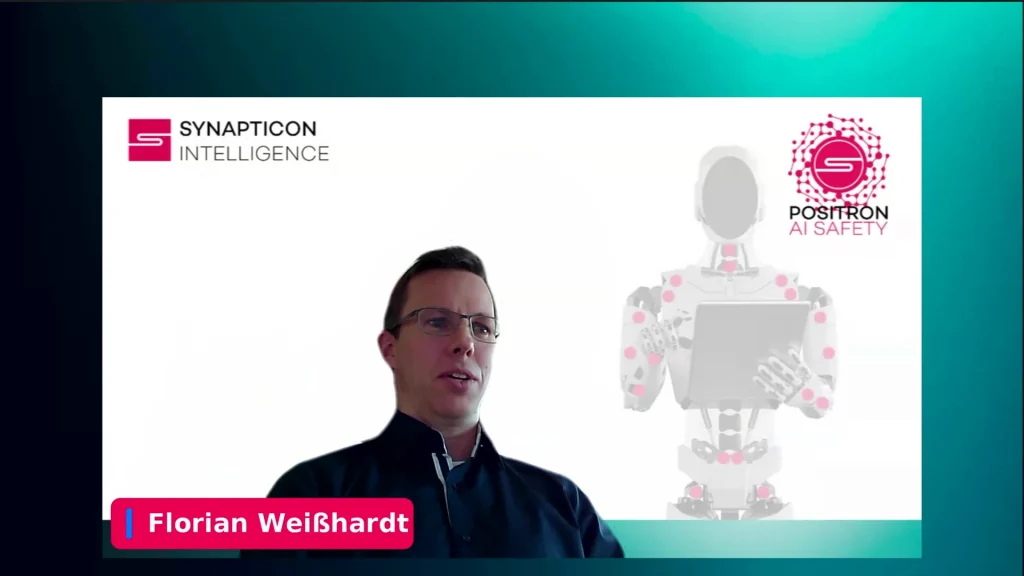
Florian Weißhardt speaking in the recorded Synapticon expert discussion. Frame from the source recording.
That makes the intended task a practical starting point. A robot standing in one place, carrying a load or moving near people creates different questions. The discussion resists treating the humanoid form factor as a sufficient description of the application.
For a development team, the editorial implication is to document the scenario being evaluated before comparing safety features. Without that context, a component list says little about how the complete machine is expected to behave.
Stability changes the meaning of a stop
The speakers use the example of an inverted pendulum to explain a balancing humanoid. If control is removed or the joints are simply locked, the machine may still fall. The point is not that stopping is always wrong; it is that the consequences depend on the robot’s state and design.
The panel describes active damping and coordinated responses as elements of Synapticon’s approach. These are supplier explanations of a proposed safety architecture. They should not be read as proof that every loss of power, sensor fault or payload condition has been resolved for an unspecified robot.
The distinction is useful when watching demonstrations. A visible emergency-stop button establishes that an operator has an input. The resulting physical behaviour, and the evidence supporting it, are separate questions.
Three connected areas of monitoring
In the recording, the architecture is explained through multi-axis safe motion, human detection and behavioural safety. Motion monitoring considers the body and its permitted movement. Human detection contributes information about nearby people. Behavioural assessment introduces the context of what the robot is doing.
The panel presents these as connected layers rather than independent checkboxes. A person’s position can affect the permitted movement of different parts of the robot. A carried object can change both physical behaviour and the consequences of contact.
Synapticon’s current product page also describes motion safety, human detection and behavioural safety as parts of POSITRON Safety AI. This confirms the supplier’s published architecture description; it does not certify a complete customer application. Supplier reference.
Questions to take into a technical review
The recording suggests a more useful review conversation than asking whether a humanoid has a stop function. What happens when control is lost? How are the body’s state and payload represented? Which functions are implemented in the selected components? What evidence covers the complete intended task?
Those questions are an editorial reading of the panel, not a compliance checklist. Their value is to separate the presence of a feature from the evidence that a defined system behaves as intended.
The source also discusses standards under development and makes certification-related statements. This article deliberately does not turn those historical remarks into a current regulatory timetable or a legal conclusion.
Questions answered
Does an emergency-stop button prove a humanoid is safe? No. It is one visible feature; the physical response and the complete system still require their own evidence.
Why discuss safety before the prototype is finished? The panel argues that actuator selection and system architecture can be affected, making later changes more disruptive.
Is this article an implementation guide? No. It explains the themes of a recorded supplier expert discussion and the questions that follow from it.
Free membership
Keep reading — it’s free.
Join with your company email to read every case study, interview and article in full. No payment, no card.